V-CORE: the shared technical engine behind the apps
V-CORE is not a standard CMS you install and forget. It is the shared technical engine powering custom online stores, warehouse and production systems (WMS), multi-role portals, guided chatbots, booking engines, and high-speed presentation websites. The admin interface and business rules change per vertical. Application layers, security, caching, media processing, automated tests, and integration patterns stay the same.


Roman
Daniel-Gabriel
Why this is not “a CMS”
A classic CMS assumes one content model everywhere: pages, plugins, themes, and the same admin screen. On V-CORE, the “CMS” layer is never one-size-fits-all. Sometimes you need a product catalog, variants, and checkout. Other times you need FIFO batch tracking, helpdesk ticketing, scored assessment forms, fleet booking, or structured content in data classes. What repeats is the engine: PHP 8.4+, CodeIgniter 4, request filters, isolated services, media pipelines, audit logging, deployment automation, and the quality gate.
Application layers (top to bottom)
Each V-CORE application is split into clean layers so the domain vertical can change without rewriting the foundation:
- HTTP / routing: public routes, admin panel, and, when the vertical requires it, an authenticated client or operator area
- Request filters: HTTPS enforcement, PageCache, HTMX detection, layout data injection, audited CSRF, rate limiting, and Shield / OAuth auth
- Thin controllers: request/response orchestration only, with no buried business logic
- Services / Libraries: payments, couriers, invoicing, OAuth / SSO, email hooks, chunked uploads and media processing, Editor.js, audit, and SEO
- Models / Entities / Migrations: domain-specific schemas built on shared data-access and validation conventions
- SSR views: PHP + Tailwind CSS (design-token system), Alpine.js for local UI state, and HTMX for partial HTML swaps without full reloads
- Ops & Deploy: local Docker, unified Makefile targets for verification, assets and production packaging, plus scheduled CLI jobs
Request pipeline: where security lives
Before business logic runs, every request walks a predictable filter chain: force HTTPS, PageCache, HTMX context, layout data injection, CSRF verification with audit logging on denial, Secure Headers, and Shield authentication, plus rate throttling on login, public forms, and search. Payment processor webhooks and callback routes are explicitly and narrowly CSRF-exempt by design, never left open by accident.
What the security layer covers
The core treats security as baseline infrastructure rather than an optional plugin:
- Custom CSRF protection with audit trail entries on rejected requests
- Rate limits on authentication, public forms, APIs, and search endpoints
- CodeIgniter Shield for sessions, RBAC roles, and isolated per-app cookies
- Google OAuth and Microsoft Entra ID SSO
- Append-only audit writer with an automatic denylist for sensitive fields
- Coming-soon / staging gate prior to production launch
- Automated security E2E checks (HTTP headers, checkout POST protection, CSP/Alpine console cleanliness)
Databases and migrations
Production defaults to MariaDB (MySQLi), with MariaDB 10.11 in local Docker and PostgreSQL supported natively in configuration. Migrations are run deliberately and scale with the domain: from a compact schema on a ticketing app or presentation site to 200+ migrations on a full e-commerce store with variations, stock ledgers, and product feeds. Conventions stay identical: a dedicated test database group, reproducible seeders, and CLI commands for rebuilding search indexes and sitemaps.
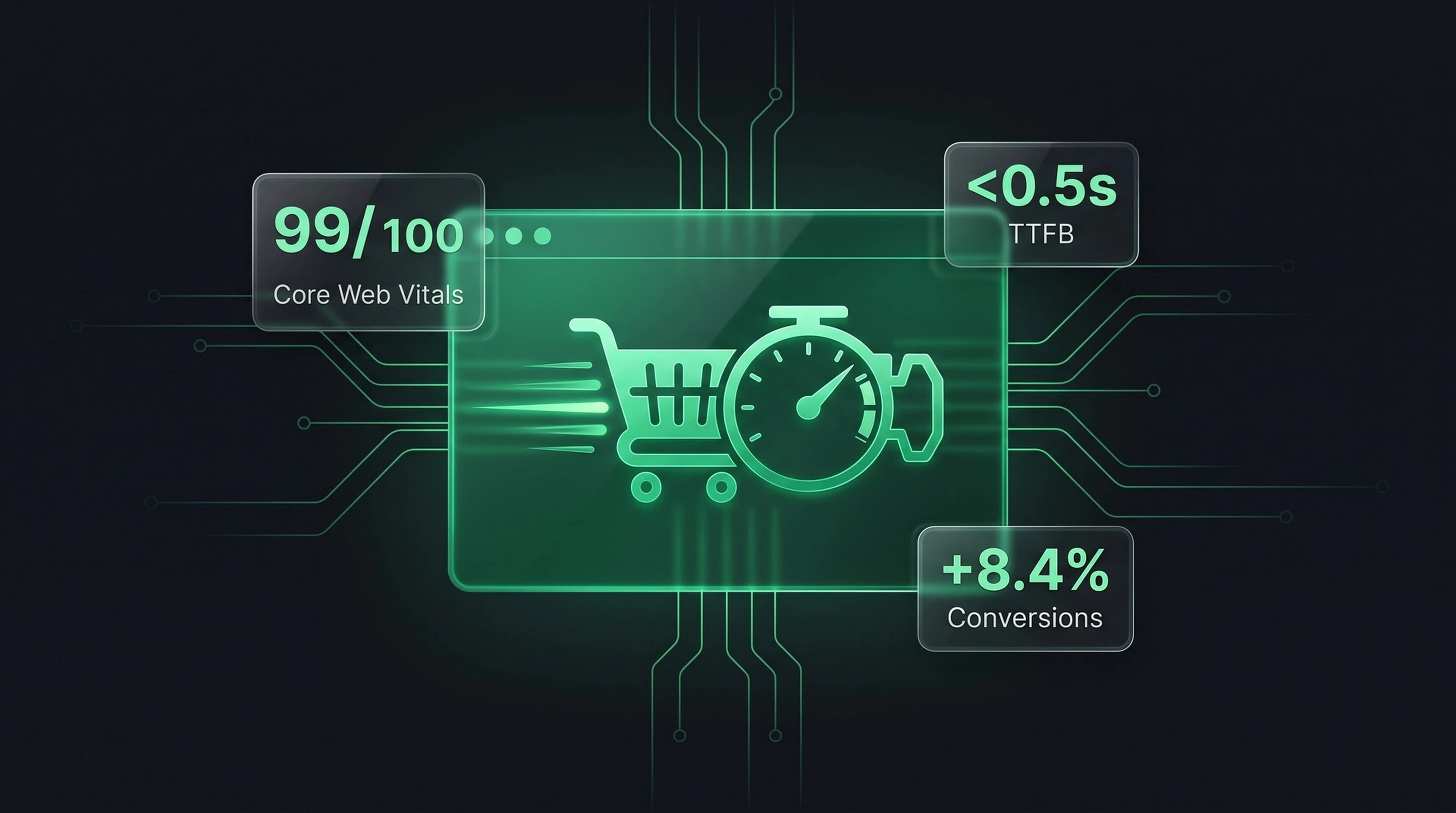
Caching layers and media pipeline
Mobile speed depends on how HTML and media assets are prepared and cached:
- PageCache on stale-safe public routes, strictly isolated from cart state, tickets, or authenticated sessions
- File-based cache by default, with Redis / Predis ready via environment configuration
- Domain caches: automated regeneration for sitemaps, product feeds, and search indexes
- Responsive image pipeline: automatic conversion to WebP + JPG across multiple sizes, dimension backfilling for zero CLS, and smooth reveal loading
- Chunked file upload for large payloads (PDF/Office/ZIP deliverables up to 200 MB or video stories) plus authenticated file streaming for private documents
Integrations: same core, vertical connectors
V-CORE does not rely on a fragile third-party plugin marketplace. It exposes clean service contracts wired directly to the tools a business actually runs:
- Card payments: EuPlatesc, BT iPay, Stripe, and Netopia, including IPN/webhook handling and payment retry flows
- Couriers and invoicing: AWB generation (Cargus, Fan Courier, Sameday) and automated invoicing (SmartBill, Saga, FGO)
- WMS and store sync
- Automated product feeds: XML feeds for Google Merchant Center, Google Local Inventory, and Meta Catalog
- Enterprise SSO: Google OAuth and Microsoft Entra ID
- Guided chat and AI: decision-tree conversation flows, embeddable JS widgets with CORS APIs, and Gemini-assisted document/verification workflows
- Communications: previewable HTML email templates, SMS, Web Push (VAPID), and in-app notifications
Test suite and quality gate
Before packaging and deployment, projects run the same automated verification pipeline:
- PHPUnit test suites running against an isolated test database
- PHPStan static analysis and automated PHP CS Fixer formatting
- Playwright + Axe checks for smoke testing, security headers, technical SEO, and accessibility
- Isolated production build verified by automated scripts, ready to run on dedicated servers, local factory hardware, or standard cPanel hosting without requiring SSH or background queue daemons
Frontend: SSR first, JavaScript only where it helps
The interface is not a heavy SPA shipping megabytes of client-side state. Pages render on the server in PHP and Tailwind CSS. Alpine.js handles local interactivity (menus, real-time field validation, modals, lightboxes), while HTMX swaps HTML fragments for catalog filtering, instant search, cart updates, and admin actions. Icons are scanned automatically from views and compiled into a minimal inline SVG bundle with zero external icon fonts.
What changes per vertical (product layer, not the core)
The same technical foundation powers four distinct product verticals:
- E-commerce (Turnkey online store): product catalog with variations and attributes, guest checkout, saved billing profiles, payments, couriers, invoicing, XML feeds, photo reviews, video stories, and guided selling chat
- Warehouse & factory (Inventory & production software): multi-location FIFO stock, frozen BOM production recipes, QR/serial unit labels, mobile PWA floor scanning, PDF delivery notes and work sheets, POS, and live store API sync
- Custom web apps & portals (Custom software development): multi-role admin and client portals with Microsoft Entra SSO, helpdesk ticketing with secret guest links, milestone/checkpoint trackers with large-file uploads, scored assessment forms, fleet booking engines, and multi-language SEO page generators
- Lead generation (Presentation website): ultra-fast SSR pages without unnecessary CMS database overhead, reCAPTCHA contact and booking forms, multi-location routing, WebP responsive visuals, and JSON-LD structured data
What this means for your project
From day one, your project sits on a production-proven technical core covering security, caching, media optimization, automated testing, and clean deployment. On top of that foundation, we build the exact workflows your operation needs without platform lock-in or fragile plugin stacks. Explore how this architecture applies to each offering on the Web development services page.
Ready to launch fast software you can rely on for years?
Tell me briefly what you want to build and your timeline.
You get a straightforward assessment and a clear proposal before any commitment.