Why Is Your Online Store Slow and How Does Page Speed Impact Conversion Rates?
In e-commerce, technical website performance is far more than a minor infrastructure detail; it is a direct factor influencing user experience, conversion rates, and marketing efficiency.

Roman
Daniel-Gabriel
Here is the updated English version with all em dashes removed:
Why Is Your Online Store Slow and How Does Page Speed Impact Conversion Rates?
In e-commerce, technical website performance is far more than a minor infrastructure detail; it is a direct factor influencing user experience, conversion rates, and marketing efficiency.
What the Data Says About Load Times and Buyer Behavior
An online store's speed directly impacts purchasing decisions. When pages respond slowly or the user interface stutters, bounce rates rise, and shoppers often abandon the site before reaching the checkout page.
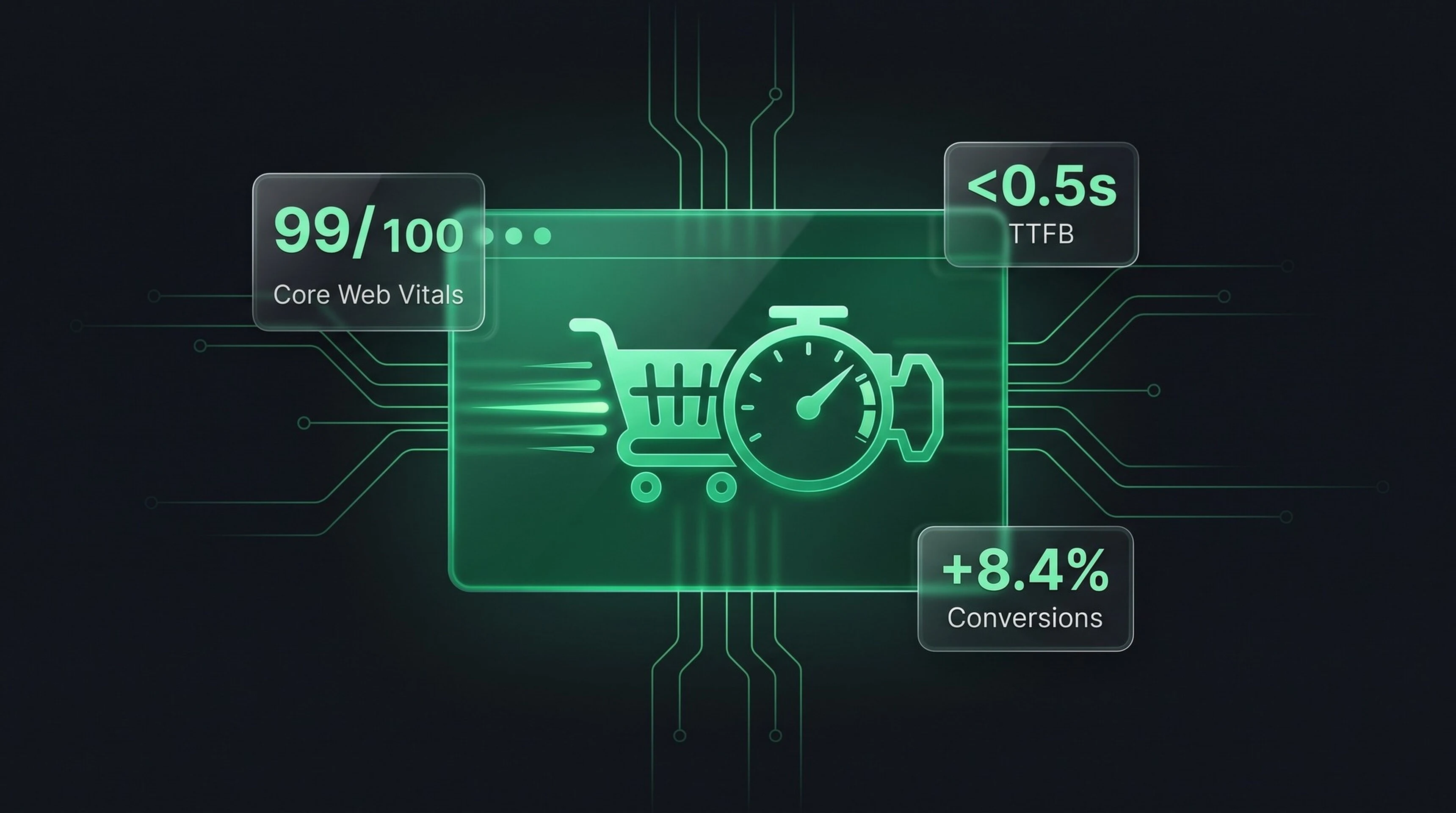
- Impact on Conversions: A study by Deloitte demonstrates that just a 100-millisecond improvement in mobile load times can increase e-commerce conversion rates by up to 8.4% and boost average order value by 9.2%.
- The Tolerance Threshold: Research compiled by Portent / iubenda reveals a significant conversion drop between sites that load within 1 to 2 seconds compared to those taking 4 to 5 seconds or more.
- Mobile Abandonment: Industry data analyzed by amasol highlights that the risk of a user abandoning a page increases steadily with every second of delay, directly eroding the ROI of paid ad campaigns on Google or Meta.
User Experience and Search Engine Visibility
Technical performance is also closely tied to how search engines evaluate your site. Google uses Core Web Vitals metrics, such as Largest Contentful Paint (LCP) and Interaction to Next Paint (INP), to measure the quality of user experience.
While a slow site isn't automatically "penalized" or removed from search results, poor technical performance can negatively affect both your long-term organic rankings and your Google Ads Quality Score, which drives up your Cost-Per-Click (CPC).
Choosing the Right Solution: Shopify, WooCommerce, or Custom Architecture?
There is no single "best" platform for every scenario. The right choice depends entirely on your business stage, catalog size, and operational complexity.
SaaS Platforms (e.g., Shopify)
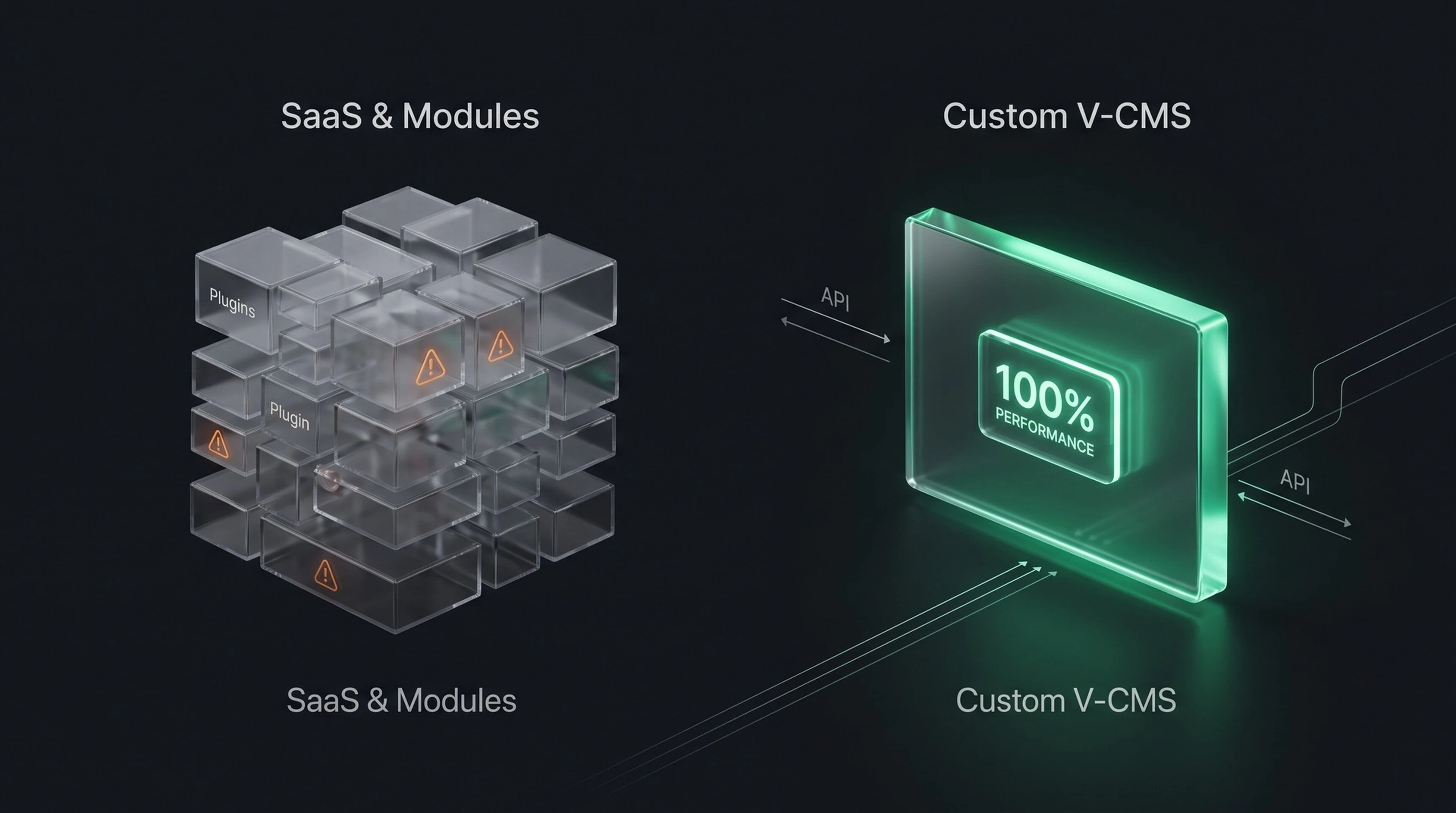
An excellent option for fast launches, market testing, or early-stage stores. They provide stable infrastructure and hassle-free management out of the box. However, as the business scales and dozens of third-party apps are added for advanced features, recurring monthly costs can accumulate quickly, and the flexibility to optimize deeply at the code level becomes constrained.
Open-Source Platforms with Modules (e.g., WooCommerce, PrestaShop)
Offer high flexibility and a rich plugin ecosystem at accessible initial costs, making them ideal for small to medium product catalogs. The challenge arises as third-party modules accumulate or catalogs scale past 1,000 to 5,000 items, where unindexed database queries, heavy filters, and plugin overhead can demand substantial server resources and careful technical maintenance.
Custom Optimized Architectures
Custom engineering makes sense when off-the-shelf platforms become the primary bottleneck to growth. This approach allows for a clean, purpose-built architecture tailored precisely to your operational flows (such as complex ERP integrations, custom inventory engines, or specialized pricing logic). By removing redundant code and unused modules, custom architectures make it possible to achieve minimal server response times (TTFB) and strong Core Web Vitals, even under heavy concurrent traffic or large product catalogs.
How to Identify and Resolve Performance Bottlenecks
Finding the exact root cause of a sluggish store requires a structured approach. Often, the core issue isn't the platform itself, but a combination of factors that can be remediated:
- Resource Optimization: Uncompressed media, non-essential third-party render-blocking scripts, or globally loaded CSS/JS bundles.
- Database and Server Optimization: Missing caching layers (such as Redis or LSCache), unindexed SQL queries, or unoptimized hosting environments.
- Architectural Evaluation: Identifying when the sheer volume of plugins or platform constraints begins to limit scalable growth.
Unsure What Is Slowing Down Your Store?
Many performance issues can be solved without migrating to a completely new platform. Whether the bottleneck lies in image compression, third-party apps, hosting configurations, database queries, or architectural limits, the first step is always an accurate technical diagnosis.
If you want to pinpoint what is holding your store back from performing at its full potential, we can run a performance audit to isolate the primary bottlenecks.
Learn more about how we build and optimize e-commerce platforms on our Online Store Development Service page.
Ready to launch high-performing software that actually drives revenue?
Let us discuss your catalog, business workflow, and timeline.
You will get an honest technical assessment and a clear path to launch.