When and why your business needs custom software development
Every business hitting an accelerated growth phase eventually encounters the rigid boundaries of standardized software applications. You often find yourself managing isolated platforms where teams lose valuable hours navigating clunky, generic workflows, while recurring licensing costs scale continuously alongside your headcount.

Roman
Daniel-Gabriel
Choosing between off-the-shelf software and a custom solution is not merely a technical choice, it is a core decision of operational strategy. In this article, we will analyze how a tailored approach impacts your Total Cost of Ownership (TCO), optimizes business processes, and under what conditions a dedicated architecture matures into a protected strategic asset.
1. Optimizing Unique Processes Without Generic Compromises
A major hurdle when deploying traditional, pre-packaged enterprise software is forced adaptation. Frequently, companies are pushed to alter their internal workflows, workflows tested and proven over years of operation, simply to fit the pre-defined constraints of a generic application. While standard solutions can enforce industry best practices in specific departments, they can become counterproductive when they disrupt the unique competitive differentiators of your business.
Custom software development allows for the retention and optimization of the exact processes that already drive value for your company, without forcing your team to adopt generic workflows that do not fit. The code is structured precisely to minimize manual workarounds and automate specialized tasks, blending seamlessly into your organization's existing operational logic.
2. Financial Efficiency and Controlling Total Cost of Ownership (TCO)
The myth that custom applications are inherently more expensive over their lifecycle deserves to be analyzed through a clear cost-benefit breakdown. For organizations handling intricate operations, high user counts, or deeply specific niche requirements, the Total Cost of Ownership (TCO) of a custom architecture can become substantially more advantageous than that of a heavily licensed software suite.
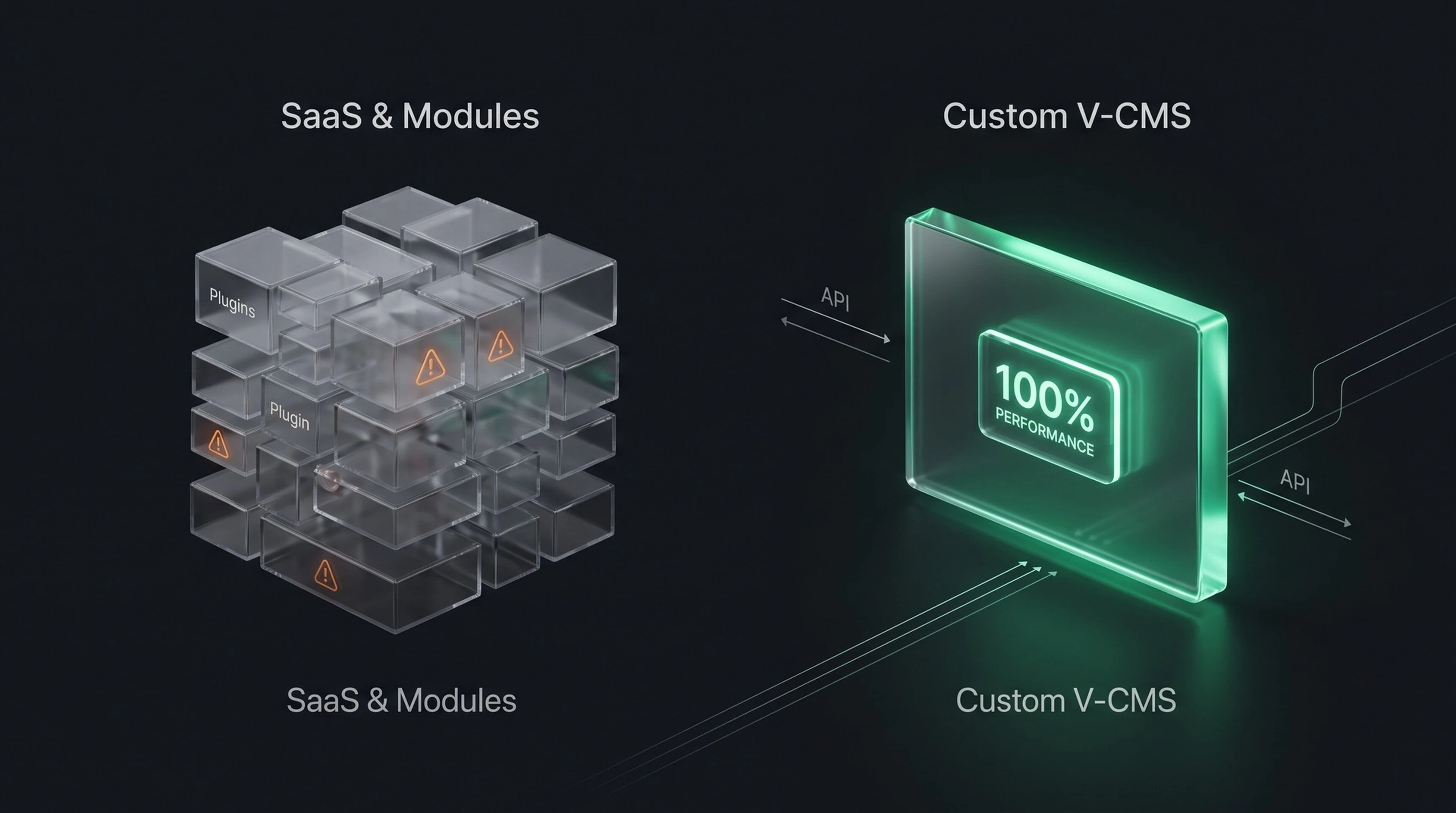
Implementing mass-market enterprise platforms, such as Microsoft Dynamics 365, can involve significant upfront licensing fees, extensive configuration costs, and specialized ongoing consulting fees, particularly for organizations with sophisticated requirements.
A dedicated custom web application can eliminate the burden of recurring seat-based SaaS licensing costs for your primary platform, ensuring a much more predictable cost model. While expanding such a platform inevitably demands additional infrastructure resources over time, expanding your user base from 5 to 500 does not automatically scale your licensing fees proportionally. Instead, the underlying computing infrastructure can be scaled gradually in direct alignment with your actual traffic and data processing needs.
3. Flexible Integrations with Your Local Software Ecosystem
Massive international software suites are designed predominantly for global markets. When a company operating locally requires direct integration with regional services, such as specific payment gateways, domestic couriers, local invoicing systems, or regional legislative reporting platforms, standardized suites often require significant custom-developed workarounds and highly specialized consulting.
With a custom application, connecting to third-party APIs is treated as a native, direct architectural task. This streamlines the implementation process, cuts down on dependencies on intermediate third-party wrapper modules, and allows your system to rapidly adapt data transfer protocols whenever local logistics or compliance regulations evolve.
4. Absolute Control Over Data Storage and Administration
In the digital economy, your operational data, your client databases, financial histories, and proprietary manufacturing recipes, represents one of your highest-value corporate assets. In typical SaaS models, the infrastructure is managed entirely by the vendor, leaving your organization dependent on their uptime policies, pricing tier adjustments, and restrictive data-export formats should you ever choose to migrate.
With a custom solution deployed on your own infrastructure or within an environment entirely under your control, your organization retains complete authority over data storage configurations, access hierarchies, and security management. This independence offers comprehensive operational security, transforming your database into a core strategic asset insulated from the changing policies of external entities.
Viziunea din spatele codului: Architecture and Enterprise Design
For these technical advantages to translate into long-term system stability, the initial structural design is critical. A successful software system is not merely a collection of pre-made parts thrown together, it is the result of rigorous planning by a software architect who deeply understands framework internals.
A deep background analyzing large-scale enterprise ecosystems, such as PHP with Symfony, gives an engineer the structural clarity needed to implement industry-standard scalability, modularity, and security practices. This architectural perspective is crucial when engineering custom engines meant to process high data volumes while maintaining optimal response times.
Custom Solutions Validated in Production Environments
This philosophy of targeted development and structural adaptability is applied directly across our portfolio projects, where centralizing disparate operations has contributed to reducing operational timelines and modernizing complex industrial workflows.
In manufacturing environments, a tight logical thread between live inventory and material planning drastically cuts down on waste. A prime example is unifying Inventory Management Systems (IMS) and resource tracking under a single, central interface.
The flexibility of custom engineering also allows for seamless adaptation to highly diverse business niches, from optimizing daily order pipelines in commercial print production to managing the multi-layered communication and maintenance ecosystems of Class-A corporate office spaces.
Conclusion: An Investment in Operational Independence
Developing a custom software system represents a long-term investment for forward-thinking enterprises that want to protect their proprietary workflows and control their scaling costs. When your core platform runs on a fast, secure, and modern technology stack within an environment you fully control, operational risks drop and your business data remains a heavily guarded, strategic asset.
If you would like to evaluate the feasibility of building a dedicated software solution engineered for your exact corporate structure, head over to our Contact page and let's map out the architecture of your next system.
Ready to launch high-performing software that actually drives revenue?
Let us discuss your catalog, business workflow, and timeline.
You will get an honest technical assessment and a clear path to launch.